
Clarification Sought on Ministry of Education’s use of ‘+’ and Schools’ Pride Week Material
As part of an international campaign, LGB International affiliates and associate organisations are asking public bodies, institutions and organisations to clarify who is included under the “+” in terms such as “LGBTQIA+”, and why those groups are placed alongside lesbians, gay men and bisexual people.
16 June 2026
For attention: Ellen MacGregor-Reid, Secretary for Education and Chief Executive
Subject: Clarification sought on Ministry use of ‘+’ and Schools’ Pride Week material
Dear Ms MacGregor-Reid, LGB Alliance NZ has read with interest the Ministry of Education’s recent Facebook post, dated 15 June 2026, promoting Schools’ Pride Week.
The post says Schools’ Pride Week is an optional way for kura to “champion inclusion and kindness” and promote belonging for “LGBTQIA+ ākonga, staff and whānau”. It links readers to the Schools’ Pride Week website, organised by InsideOUT Kōaro, for resources and activity ideas.
One activity suggested for high school students invites them to find “old out of date literature around gender and sexuality” and, using the blackout/erasure method, create “affirming poetry”. Although the post says Schools’ Pride Week is not mandatory, the Ministry’s public promotion of the material gives it official weight and credibility.
We are writing to ask what the Ministry understands the “+” in “LGBTQIA+” to represent.
Who are the “+” ākonga, staff and whānau the Ministry is referring to? What are their characteristics, and on what basis are they grouped with lesbians, gay men and bisexual people in Ministry communications and school-facing material?
LGB Alliance NZ is the working name of LGB Alliance Aotearoa New Zealand and is an Associate Member Organisation of LGB International. We exist to promote and defend the rights and interests of lesbians, gay men and bisexual people. On 12 June 2026, LGB International launched its “What’s behind the +?” campaign.
It is already unhelpful that our views and interests are routinely conflated with those of people grouped under gender identity, sex characteristics and queer identities. The addition of an undefined “+” is more concerning still, because it can appear to include unnamed groups without explaining who they are or why they are placed alongside lesbians, gay men and bisexual people. Sexual orientation and gender identity share no common ground. In practice, many proponents of gender identity frameworks hold views that are directly at odds with same-sex attraction.
Lesbians, gay men and bisexual people are defined by sexual orientation: the sex of the people to whom we are attracted. Gender identity, by contrast, concerns self-identification and belongs to a different category. If gender identity is treated as replacing sex, then sexual orientation is no longer predicated on sex, and homosexuality can no longer be clearly understood as same-sex attraction. That is a serious concern for lesbians, gay men and bisexual people.
This is particularly concerning in schools, where material promoted to students may shape how heterosexuality, homosexuality, bisexuality, sex and gender are understood. The phrase “gender and sexuality” also appears to merge distinct matters: sex, sexual orientation, gender identity, and beliefs about affirmation. If material that recognises homosexuality as same-sex attraction, maintains sex as the basis of sexual orientation, or uses sex-based language is treated as “out of date”, that would raise serious concerns for lesbian, gay and bisexual students, staff and whānau.
We would therefore be grateful if the Ministry could clarify:
1. What does the “+” in “LGBTQIA+” mean in the Ministry’s Schools’ Pride Week post, and which people or groups does the Ministry understand it to include?
2. Which groups are included in the Ministry’s references to “rainbow staff and students” and “LGBTQIA+ ākonga, staff and whānau”?
3. What characteristics do these groups share with lesbians, gay men and bisexual people, and why are they grouped together?
4. Does the Ministry endorse, or consider appropriate for school use, the InsideOUT Kōaro activity inviting students to use “old out of date literature around gender and sexuality” to create “affirming poetry”?
5. What does the Ministry understand the phrase “old out of date literature around gender and sexuality” to mean?
6. Does the Ministry consider it appropriate to encourage students to erase or repurpose earlier material about sex, sexuality and gender through a present-day “affirming” framework?
7. Specifically, would material that defines homosexuality as same-sex attraction, rather than same-gender attraction, or that maintains sex as the basis of sexual orientation, be considered “out of date” or insufficiently “affirming”?
8. Does the Ministry recognise that gender identity frameworks may conflict with the rights and interests of lesbians, gay men and bisexual people?
9. Would the Ministry consider using clearer language that distinguishes sexual orientation from gender identity, sex characteristics, cultural identity and other categories?
Where the Ministry promotes terms such as “LGBTQIA+” or “rainbow” in school-facing material, it should be clear who is being referred to and why those groups are being placed together. It should also be clear that same-sex attraction, sex-based language and the ability of lesbians, gay men and bisexual people to describe our own sexual orientation accurately are not being treated as outdated.
We look forward to hearing from you.
LGB Alliance NZ
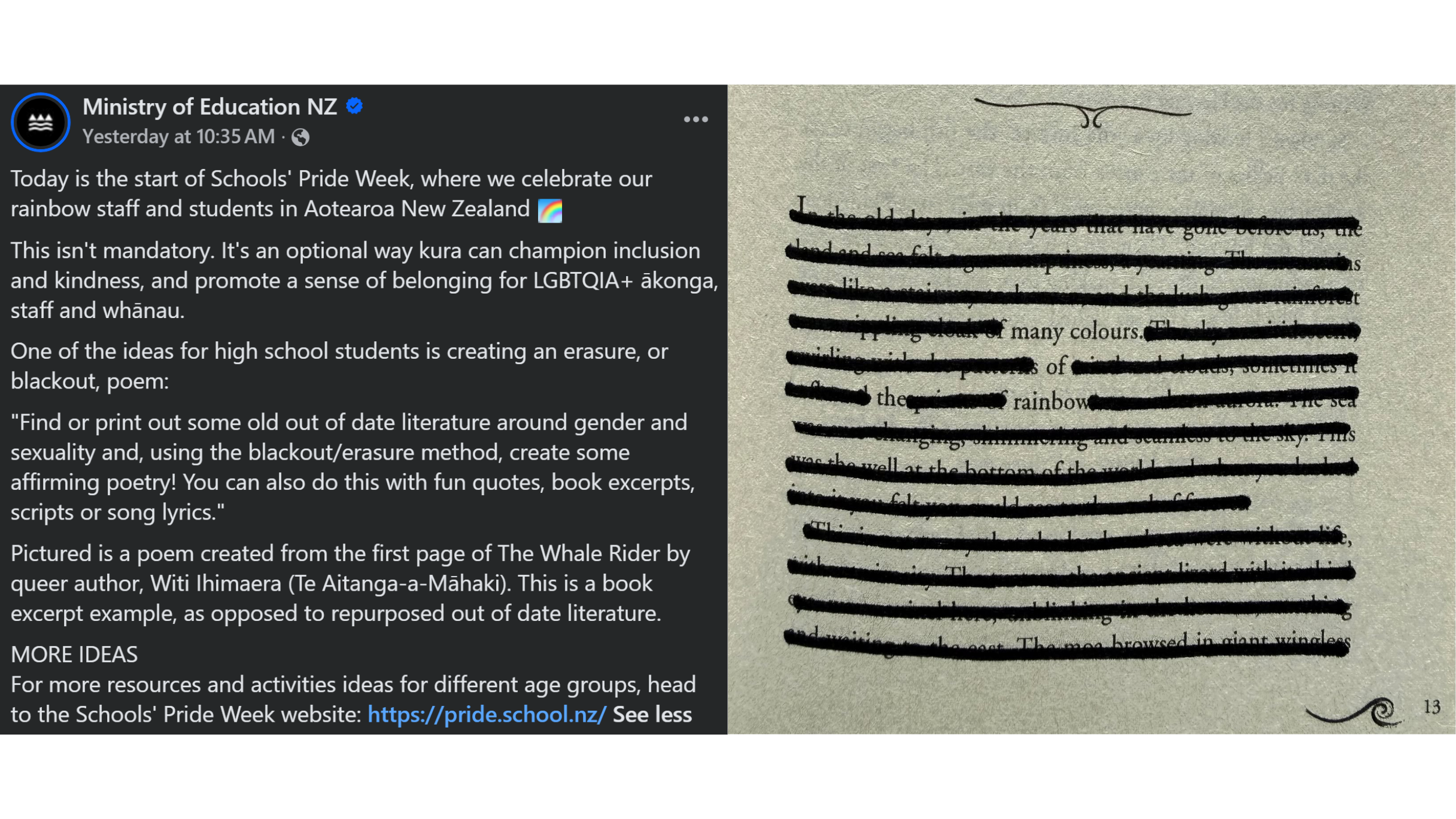
Image. Ministry of Education NZ’s Facebook post on 15 June 2026